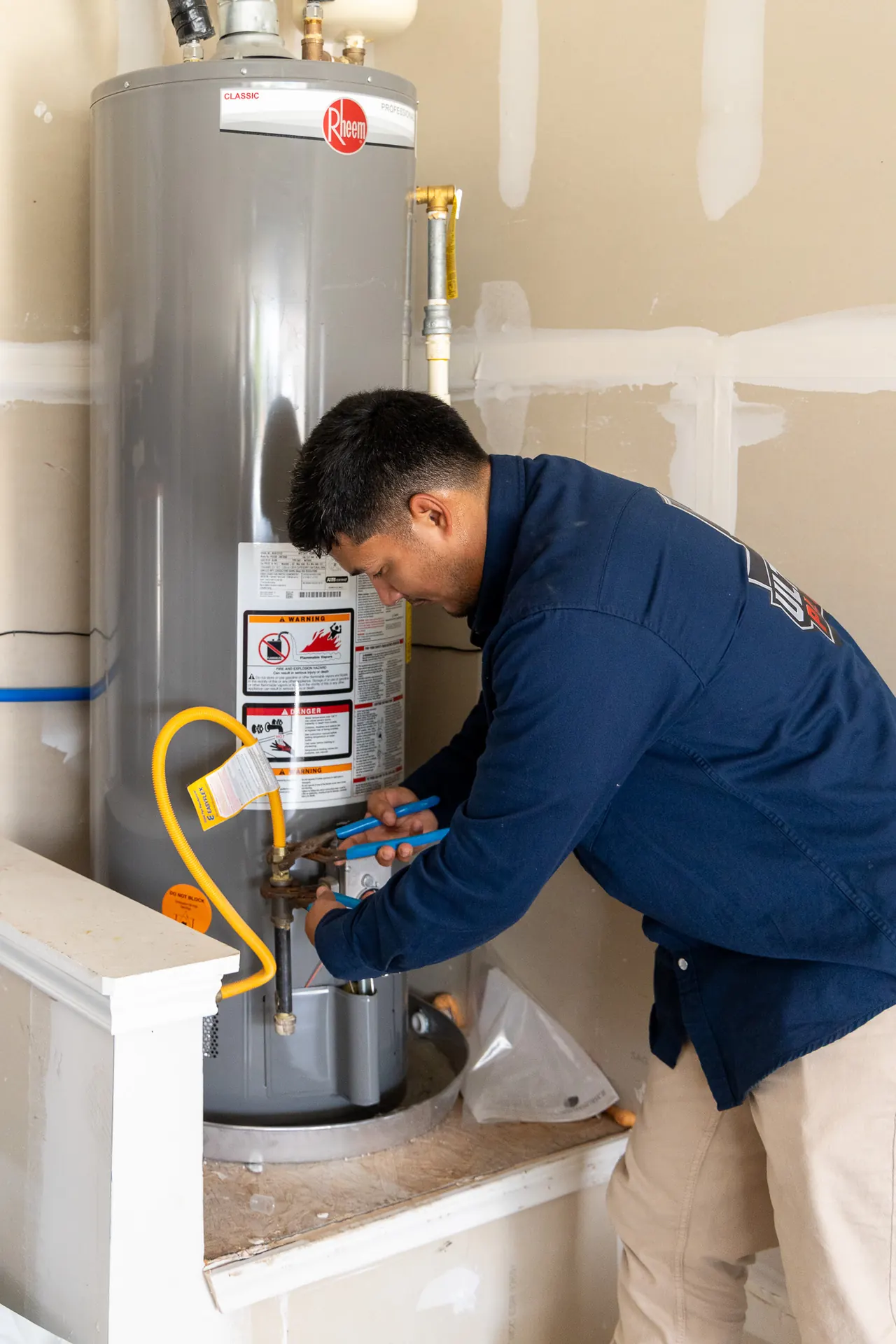
A water heater leaking in your garage should be shut down today: turn off the cold water going into the tank, then turn off the power or the gas. Once the water stops feeding the tank, you can look for where the leak starts, and that tells you whether you are looking at a small repair or a new heater.
What should you do in the first few minutes?
The first job is to stop new water from reaching the tank. The cold water shut-off valve is on the pipe at the top of the water heater. Turn it off.
Next, turn off the heat source. For an electric water heater, flip its breaker off at the panel, but only if the floor around you is dry. For a gas water heater, turn the control to "off" or "pilot". A.O. Smith, a water heater maker, gives the same order in its own water heater maintenance guide: shut off the cold water inlet, then turn a gas unit's dial to OFF or switch an electric unit off at the breaker.
Keep clear of the hot water. The tank and the pipes coming out of it can burn you, so do not try to drain the tank or work on the fittings while the water is hot.
Then move anything stored near the heater off the wet floor and wipe up what you can. A garage floor hides a slow leak well, so the puddle may have been growing for a while.
What if you smell gas?
If you smell gas, stop what you are doing and leave the garage and the house. Texas Gas Service says natural gas is given a smell on purpose so people notice it, and that anyone who smells it should leave right away and call 911 and the gas company from outside.
Do not try to find the leak yourself. Texas Gas Service also warns against flipping a light switch, using a phone, opening or closing the garage door, or starting a car nearby, because any of those can make a spark. Make the calls once you are a safe distance away.
Where is the water coming from?
Most water heater leaks start in one of four places: the relief valve, the drain valve, a fitting on top, or the tank itself. Look before you wipe everything dry, because the wet spot points to the cause.
The relief valve on the side or top
The temperature and pressure relief valve is the safety valve on the side or top of the tank, usually with a pipe running down toward the floor. A.O. Smith explains that both gas and electric tanks have one, and it opens to let pressure out if the tank gets too much.
A relief valve that drips is often doing its job. A.O. Smith says these valves drip when the water pressure is too high or when water expands as it heats in a closed system, and it tells owners to fix the pressure and add a thermal expansion tank before swapping the valve. Do not cap or plug that pipe. A.O. Smith warns that a tank whose relief valve does not work can over-pressurize and explode.
The drain valve near the bottom
The drain valve is the spigot near the bottom of the tank. A.O. Smith notes that sediment builds up inside the tank and can clog this valve, and a valve that does not close all the way will drip. A drip here is often a valve problem rather than a tank problem.
The fittings and lines on top
Water running down the outside of the tank from above usually starts at the pipe connections, the shut-off valve or a supply line on top. Dry the top and watch for a fresh drop. If the water is on the floor but you cannot see where it comes from, it may not be the water heater at all, and our leak detection service finds hidden leaks.
The tank itself
Water coming from under the tank, with the valves and fittings dry, usually means the tank is leaking. A tank that leaks from the body cannot be patched. That is when it is time to talk about a replacement.
Can you keep using it until the plumber comes?
You can keep the heater off until a plumber looks at it, and you should. Leave the cold water valve closed and the power or gas off. Your home will be without hot water for a while, but a shut-down heater cannot keep filling the garage.
What happens after the leak is fixed?
Once the heater is working again, a little yearly care helps it last. A.O. Smith recommends testing the relief valve once a year, having a professional inspect it every 5 years, checking the anode rod and replacing it when it is worn, and flushing the tank to clear sediment.
When should you call a plumber?
Call a plumber when the leak is coming from the tank, when the relief valve keeps dripping, or when you are not sure where the water starts. Our water heater repair and replacement team works on gas and electric tank water heaters. We find where the leak comes from, stop it, and tell you whether a repair makes sense or a new heater is the better call. We work on tankless water heaters too.
A leaking water heater at night or on a weekend does not have to wait. Ultimate Plumber answers emergency calls 24/7 at 512-828-3835. The company is owned by Mickey Pesina, Texas Master Plumber M-46456, and serves homes across Austin and nearby towns.